Application Notes
Ophthalmic Surgery
Ophthalmology is the branch of medicine that deals with the anatomy, physiology and diseases of the eye. The laser is particularly suited to ophthalmic surgery since it can provide a non-contact method of interacting with the cornea or even the interior of the eye, including the lens and the retina.
Application Notes
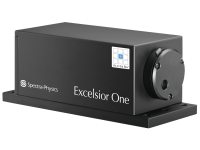
Super-Resolution Microscopy (STED and PALM)
One super-resolution approach is called stimulated emission depletion (STED) microscopy. This technique uses a confocal microscope and a diffraction limited excitation beam that is scanned across the sample.
Application Notes
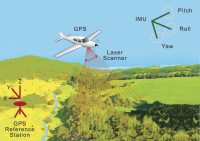
LiDAR
LiDAR is an active remote sensing technique that is similar to RADAR but, instead of using radio waves as a radiation source, it uses laser pulses. In this technique, a laser source emits pulses that are directed towards the target of interest.
Application Notes
Flat Panel Display Manufacturing
As the flat panel display market moves from LCD to OLED display technology, laser patterning and cutting of heterogeneous materials (comprised of multiple organic material films) with high quality and accuracy is needed.
Application Notes
PCB Manufacturing
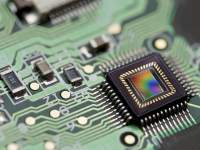
Lasers are routinely used in a variety of PCB manufacturing processes including via drilling, depaneling, profiling, laser direct imaging, repair, trimming, and marking. Laser processing completely eliminates mechanical stress on the material.
Application Notes
Solar Panel Manufacturing
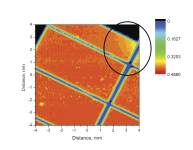
Crystalline-Silicon solar cells are the predominant solar cell technology used in fabricating solar panels because of the availability of silicon, well-developed manufacturing processes, and the high conversion efficiencies that can be achieved.
Application Notes
Semiconductor Inspection
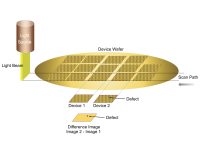
In this application note, we provide a brief description of the basics of wafer and reticle inspection techniques and discuss the characteristics of current inspection tools.
Application Notes
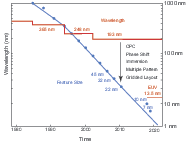
Semiconductor Lithography Overview
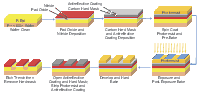
Lithography is defined as "a method of printing from a flat surface (such as a smooth stone or a metal plate) that has been prepared so that the ink will only stick to the design that will be printed".
Application Notes
Deep UV Photolithography
DUV technology for photolithography is exclusively based on projection optics since the pattern on the photomask is much larger than the final pattern developed on the photoresist.
Application Notes
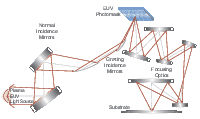
Extreme UV Photolithography
EUV lithography is being developed to fulfill single-exposure patterning requirements at feature sizes below 22 nm. Unique to this technology is the nature of the light source.
Application Notes
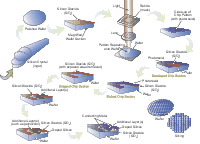
Semiconductor Manufacturing Overview
This application note provides a brief overview of semiconductor manufacturing and describe the various optical techniques used to define, inspect, and measure feature sizes and layer properties throughout the manufacturing process.
Application Notes
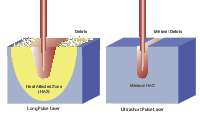
Laser Micromachining
Laser machining is a non-contact process that can achieve higher precision and quality, smaller features, improved consistency with no tool wear, and possesses the flexibility to machine different materials.
Application Notes
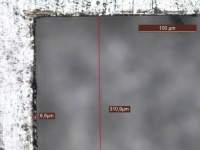
Laser Macroprocessing
Laser macroprocessing is defined as the machining of metal parts with thicknesses greater than a mm to produce large features with multi-mm dimensions. The process uses high power lasers with typical average powers ranging from a few hundred W to many kW.
Application Notes
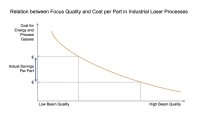
Real-Time Laser Power Measurement
Only when performing optimally can laser systems guarantee the most cost-effective production of high-quality components. Even the smallest deviations in beam adjustment or focal position may lead to reduced part quality, massive cost increases, and pollution of the environment.
Application Notes
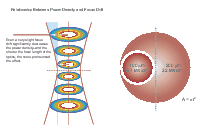
Non-Contact Laser Beam Measurement
A non-contact method developed by MKS Ophir is based on Rayleigh scattering. Rayleigh scattering is the scattering of light by particles that are smaller than the radiation's wavelength, e.g. by oxygen or nitrogen molecules in the air.

Application Notes
Thermal Imaging
Thermal imaging techniques involve discriminating between various objects in a scene based on their respective differences in temperature.
Application Notes
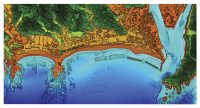
LiDAR Application Examples
The accuracy and detail provided by LiDAR makes it an essential component of many applications that help local authorities and other land management organizations in their areas of responsibility. Shown are examples of LiDAR applications that use Spectra-Physics lasers.
Application Notes
Data Communications
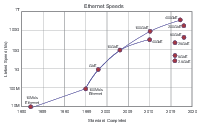
here has been a tremendous increase in the volume of internet-based digital data communications over the past decade, with global cloud data center traffic reaching 8.2 zettabytes in 2017 alone.
Application Notes
Advanced Bioimaging Overview
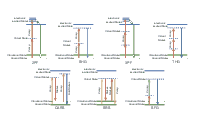
Multiple advanced bioimaging techniques have been developed to improve the axial resolution and allow a true 3D representation of the sample to be reconstructed.
Application Notes
Photoacoustic Microscopy (PAM)
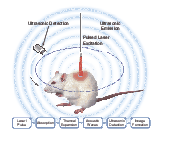
Unlike the pure optical microscopy techniques, PAM takes advantage of the weak acoustic scattering in tissue and thus breaks through the optical depth penetration limit (~ 1 mm) in soft tissues.
Page 1 of 9